
Military Personnel Support Programmes: A Practical Institutional Use for HOLDERCARD
Updated: 5 days ago
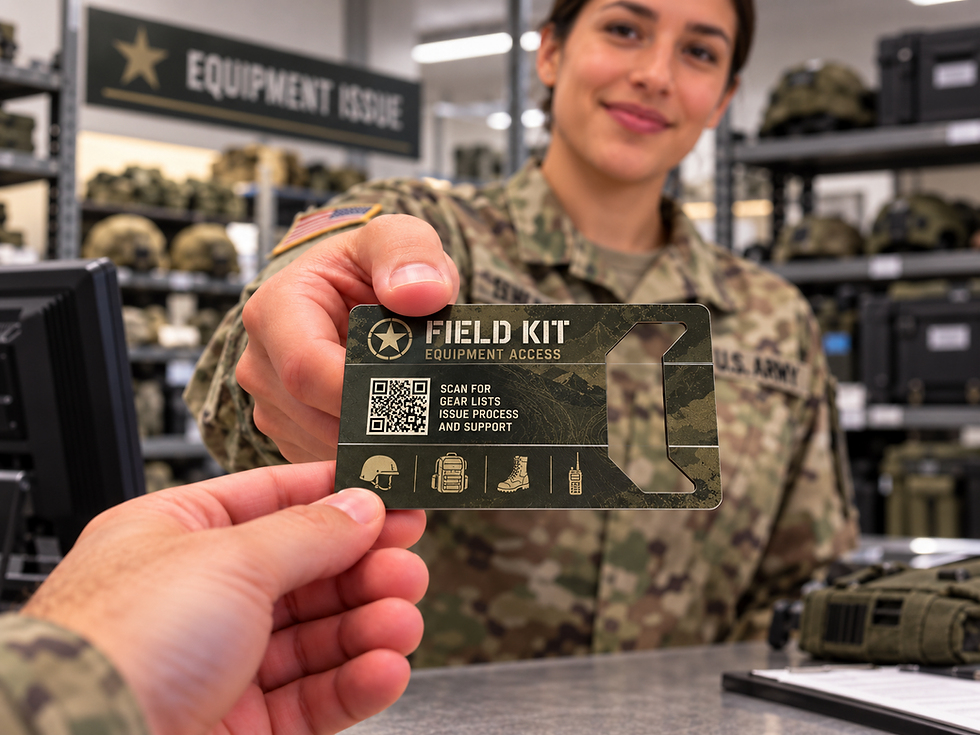
A defence organisation does not need another souvenir. It needs support information that reaches service members, remains available and is easy to find when needed.
HOLDERCARD offers an institutional communications concept: a printed, wallet-sized physical advertising medium that can also be folded into a smartphone support. The useful feature is a reason to retain the printed message; the purpose is to keep approved welfare and service information visible.
Why a commander or procurement team might fund it
The potential value is organisational rather than decorative. A central welfare programme can provide one consistent point of contact across approved onboarding packs, family-support materials, rehabilitation centres and administrative handouts. Instead of distributing a disposable flyer, the organisation issues a practical object that carries the same approved message.
This is a proposal to evaluate, not a proven defence procurement saving, a guaranteed wellbeing outcome or an existing military contract.
The strongest use case: a welfare contact that stays with the recipient
One side may carry the sponsoring organisation's approved identity and the message 'Support for service members and families'. The other may list a stable public support telephone number, a short verified URL and an optional QR code leading to a formally approved information service.
Useful destinations could include official family support, benefits guidance, veterans' transition resources or authorised administrative help. The issuing authority chooses and maintains every destination. The card must not suggest that HOLDERCARD operates or endorses any government service.
What the leadership gains
A standardised, consistent communication asset; a physical reminder of available support; a repeatable format for bulk distribution; and a way to evaluate whether the handout remains useful. The branded surface can represent a public welfare programme, authorised partner or institutional sponsor, rather than becoming a promotional souvenir.
Leadership can compare real pilot outcomes with its current leaflets and information packs before authorising scale. A QR code can count aggregate visits where permitted; it does not prove improved welfare and should not track named soldiers, units or locations.
How a responsible pilot could work
1. The programme owner approves the service, budget, privacy rules and permitted distribution points. 2. A small test batch uses one approved message and a stable destination. 3. Distribution takes place in an authorised, non-operational setting. 4. The team collects anonymous usefulness feedback and, if permitted, aggregate visits. 5. Procurement reviews actual cost per issued and retained item, defects, feedback and any administrative burden before considering a larger order.
A budget should show unit price by quantity, design approval, printing, distribution and any maintenance of the destination. No savings, uptake rate or retention percentage should be promised until measured.
Security, medical responsibility and limitations
No unit identifiers, deployment details, names, personal data or location tracking should appear on the card or in QR analytics. Phone use must follow local operational-security rules. QR destinations require approval and periodic review; no uncontrolled redirect to medical advice or sensitive systems.
The card is not a medical device, IFAK component, emergency guide or alternative to professional care. Any medical information must remain in authorised clinical systems. The phone-support function is incidental and must never be presented as a treatment or tactical capability.
Why this fits a B2B institutional campaign
For HOLDERCARD, the client is the organisation ordering an approved, branded physical communication medium in quantity. The beneficiary is the person who keeps it. Repeated everyday usefulness may extend exposure to the welfare message; a pilot must determine whether that happens in practice.
Official context and next step
Ukraine's Ministry of Defence describes active social-support groups that help service members and families navigate administrative, legal and medical questions. This independent proposal does not imply a relationship with or endorsement by the ministry.
For an institutional feasibility review, request samples, an actual quotation for the intended quantity and a draft of the organisation-approved message.


Comments