
From SIM Carrier to Phone Stand: Turning Mobile Onboarding into a Lasting Brand Touchpoint

A SIM card is one of the most important physical objects in the relationship between a mobile operator and a new customer.
For a few minutes.
The customer receives it, removes the SIM, inserts it into a phone — and the carrier around it has completed its original purpose.
It is normally discarded almost immediately.
That creates an unusual contradiction.
Mobile operators spend heavily on customer acquisition, retail experience, mobile onboarding and telecom branding. Yet one of the first branded physical objects handed to a new subscriber is often designed to become useless as soon as the service begins.
What if SIM card packaging did not become waste after activation? What if it became something the customer continued to use with the very device the operator had just connected?
Holdercard creates a new business scenario for mobile network operators, MVNOs, SIM manufacturers, telecom retailers and eSIM providers.
A physical SIM can be supplied inside a specially designed Holdercard with removable internal elements. The customer breaks out the SIM in the normal way, removes the small internal section required for the folding mechanism — and the remaining card becomes a smartphone stand.
The SIM starts the connection. The Holdercard stays with the customer.
SIM card packaging can do more than protect the SIM
Traditional SIM card packaging solves a manufacturing and distribution problem very well.
The SIM itself is tiny. It needs a larger carrier so it can be personalised, printed, transported, handled in a store and delivered safely to the customer.
The carrier is also a valuable telecom branding surface. It can carry activation instructions, customer-service details, QR codes, plan information and the operator's visual identity.
But once the subscriber removes the nano-SIM, most conventional carriers have little remaining value.
The telecom industry has responded mainly by reducing material, simplifying packaging and moving toward eSIM. Those trends make sense. But they also raise another useful design question: can the remaining physical object do more?
Holdercard is strongest where the operator already wants to provide a physical welcome card, activation card, customer-service card or promotional object. Instead of producing an item whose usefulness ends at activation, the operator can create one whose second function begins at activation.
Break out the SIM. Keep the carrier.
The physical concept is simple.
Holdercard can be engineered with removable internal sections. The physical SIM is integrated into an appropriate break-out section of the card. A second removable element can form part of the Holdercard folding construction.
During mobile onboarding, the customer removes the SIM and the required internal tab.
What remains is the Holdercard.
Fold it — and the former SIM carrier becomes a smartphone stand.
Remove your SIM. Activate your service. Keep the card. Use it with your phone.
For a mobile operator, the relevance is immediate. This is not a random promotional pen, keyring or giveaway. It is a telecom promotional product designed specifically for the smartphone that has just been connected.
A lasting physical reminder of the mobile operator
Telecom services quickly become invisible after activation.
The SIM disappears inside the device. The network works in the background. Billing becomes automatic. The operator may appear in an app or on a monthly statement, but the physical relationship with the customer largely disappears.
Holdercard creates a small physical reminder of the brand.
The operator logo can remain on a desk, bedside table, kitchen counter, hotel room desk or workspace every time the subscriber uses the phone stand.
Because Holdercard fits into a wallet, the customer can also keep it close instead of treating it as packaging.
The value is not aggressive advertising. It is passive brand visibility created through usefulness.
The QR code becomes a shortcut back to the operator
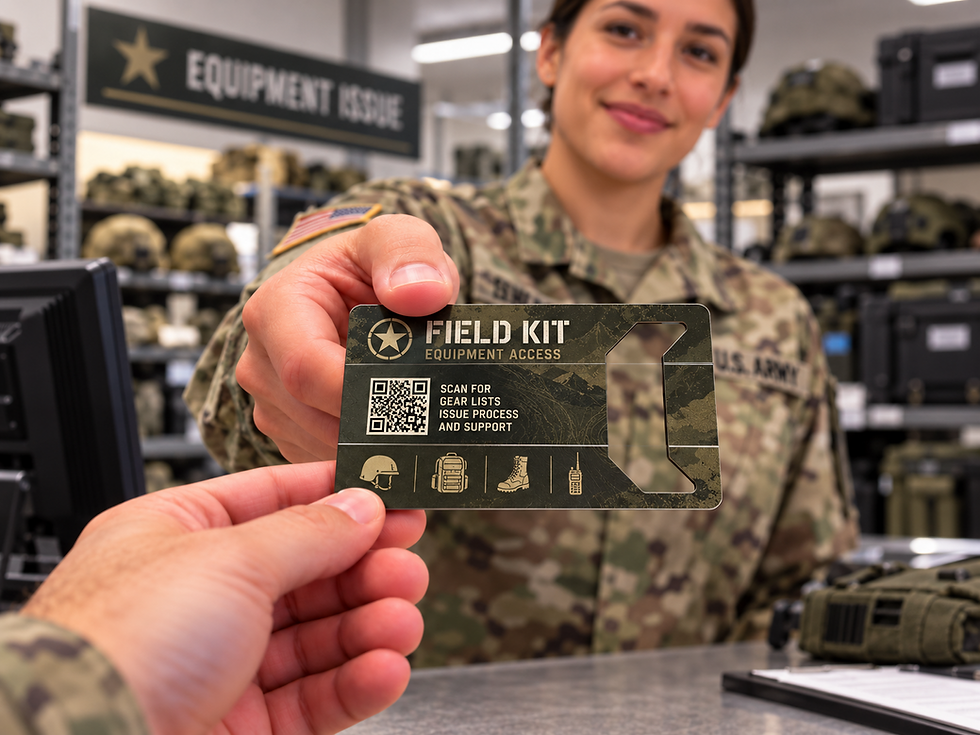
A QR code can turn Holdercard into a permanent physical entry point to the operator's digital ecosystem.
Depending on the mobile service provider, the QR code could lead directly to:
SIM activation;
eSIM activation;
the customer account;
the operator's mobile app;
balance and mobile data usage;
top-up services;
roaming packages;
SIM replacement;
number transfer;
customer support;
network coverage information;
loyalty benefits;
device upgrades;
referral programmes;
broadband or converged offers.
Instead of asking customers months later to remember which app to download or where a particular service is located, the operator has already given them a recognisable physical shortcut.
Scan the card you received with your SIM.
If a managed QR destination is used, the destination can also change over the lifetime of the card. During onboarding it might lead to activation. Later it can lead to the customer area, roaming, support, upgrades or loyalty.
One physical object can therefore support several stages of the customer lifecycle.
Physical SIM today, eSIM tomorrow
The growth of eSIM does not remove this business scenario. It creates a second one.
eSIM reduces the need for physical SIM distribution and makes activation increasingly digital. That is operationally attractive for mobile operators, but it also removes another physical brand touchpoint from the onboarding journey.
For an eSIM customer, Holdercard does not need to contain a physical SIM at all.
It can become a compact eSIM activation card, welcome card and customer-service card.
WELCOME TO [OPERATOR] — Your mobile services, one scan away.
The QR code can initially direct the subscriber to eSIM activation and later serve as a gateway to the operator's account, app, support and loyalty ecosystem.
The connectivity becomes digital. The useful branded object remains physical.
eSIM activation still needs clear customer onboarding
Digital activation can be technically simple while still being unfamiliar to many customers.
A physical welcome card gives the operator a simple communication surface for explaining eSIM activation, device transfer and support without forcing the customer to remember a long sequence of instructions.
YOUR eSIM — Scan to activate, transfer or manage your mobile service.
After activation, those instructions do not become useless because the card itself turns into a smartphone stand.
Scan. Activate. Fold. Use.
There is a natural interaction between the QR code and the physical function.
The customer scans the activation QR code or service link, completes the SIM or eSIM setup, folds Holdercard and places the newly connected smartphone onto it.
Scan. Activate. Fold. Use.
For a telecom marketing team, this is a far more coherent branded experience than putting an unrelated promotional giveaway inside a welcome pack.
A strong format for MVNO marketing
The concept can be particularly attractive for MVNOs.
Virtual mobile operators often compete in markets where the network infrastructure itself is invisible to the customer. Tariffs can also be easy to compare, which makes mobile brand identity, customer onboarding and retention increasingly important.
A Holdercard-based SIM or eSIM welcome card gives an MVNO a compact branded object without requiring a large promotional merchandise programme.
the MVNO brand identity;
the physical SIM where required;
eSIM or SIM activation;
the mobile app download;
customer support;
top-up access;
referral offers;
a loyalty route;
and a practical function after activation.
For a digital-first mobile brand, Holdercard can become the physical manifestation of an otherwise digital service.
Prepaid SIM and travel SIM packaging
Prepaid SIM and travel SIM products create another strong use case.
They may be sold through airports, convenience stores, electronics retailers, hotel desks, supermarkets, travel retail and vending locations.
The customer often has little prior relationship with the operator. The packaging therefore has to identify the service, explain activation, communicate the plan and establish trust quickly.
A Holdercard SIM pack can perform those initial jobs and then survive the purchase.
A traveller can remove the SIM, activate the service, fold the carrier and use it as a phone stand in a hotel room, airport lounge, train or café.
The QR code can remain useful for checking data, topping up the account, accessing support or buying another roaming package.
A telecom service menu that stays in the wallet
Mobile operators offer many services that customers rarely discover until they actively need them.
Holdercard can become a simple physical doorway to the operator's digital service menu.
MY MOBILE — Scan for account, support, upgrades, roaming and rewards.
The subscriber does not need to remember where everything is. The object becomes the memory.
From customer acquisition to customer lifetime
Traditional SIM card packaging belongs almost entirely to the acquisition moment. Holdercard allows the same physical item to participate in the customer lifetime.
Day one
SIM or eSIM activation.
Week one
App installation and account setup.
Month three
Customer support, top-up or service management.
Holiday
Roaming package or travel support.
Year two
Device or tariff upgrade.
Throughout this period, the same card can remain useful as a phone stand and recognisable as the operator's access point.
It creates something conventional disposable packaging cannot provide: a persistent physical route back to the brand.
One format, several telecom business scenarios
MOBILE NETWORK OPERATOR
Physical SIM card packaging that transforms into a branded smartphone stand after activation.
eSIM PROVIDER
A physical welcome and service card with eSIM activation, account and support access without requiring a physical SIM.
MVNO
A compact branded object that gives an otherwise digital telecom service a physical identity.
PREPAID SIM
Activation, top-up and account access combined with a useful take-away product.
TRAVEL SIM
Connectivity instructions, roaming and data-management access combined with a phone stand useful during the trip.
DEVICE BUNDLE
Included with a new smartphone as the connection card for the mobile operator activating the device.
CORPORATE MOBILE
A company connectivity card giving employees access to telecom support, account information or device-management resources.
LOYALTY & RETENTION
A persistent QR access point for rewards, upgrades, referrals and additional mobile services.
Sustainability means getting more useful life from the object
The sustainability argument should be made carefully.
A useful physical product is not automatically more sustainable simply because it has a second function. eSIM can eliminate physical SIM packaging entirely, and many operators are already reducing the material used in physical SIM distribution.
Holdercard therefore makes the strongest case where an operator is already distributing a welcome card, activation card, retail pack, promotional item or physical customer communication.
The right question is: can one useful object replace several short-lived ones?
a SIM carrier;
a welcome card;
a QR activation card;
a promotional giveaway;
a service reminder.
The goal should not be to create more material. It should be to extract more useful life from the material that is deliberately distributed.
The bigger idea: the SIM carrier does not have to die when the SIM is removed
For decades, the telecom industry has treated the SIM carrier as temporary infrastructure.
Holdercard suggests a different lifecycle.
Before activation, it carries the connection.
During activation, it explains the service.
After activation, it holds the phone.
Throughout its useful life, it can lead the customer back to the operator.
For physical SIM customers, the SIM itself can break out of the card. For eSIM customers, the QR code can become the activation and service gateway. For both, the remaining Holdercard becomes something the customer has a reason to keep.
The SIM leaves the card. The brand does not have to.


Comments