
From Field Rest to Medical Support: A Small Physical Tool for the Modern Soldier
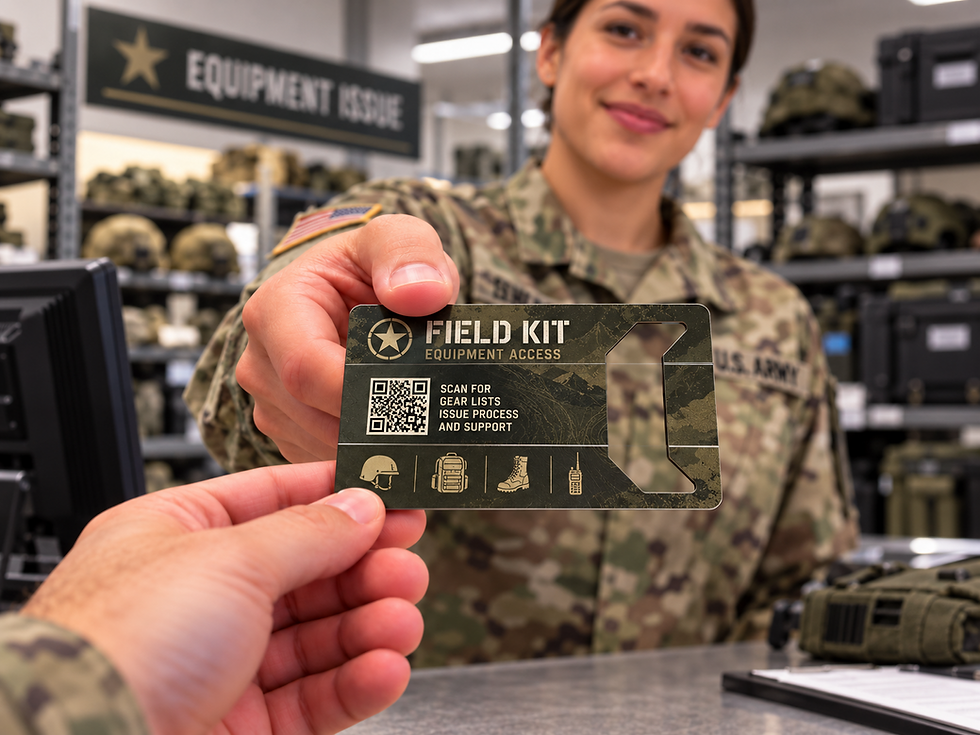
Military equipment is designed around necessity.
Every gram, every pocket and every object carried by a service member needs a reason to be there.
Yet one object has become increasingly important across everyday military life, training, deployment, recovery and medical support: the smartphone.
When operational rules permit its use, a phone can be a connection to family, a source of approved information, a training tool and, in some military medical environments, part of a digital healthcare or telemedicine workflow.
But the phone itself creates a very ordinary physical problem: it still has to be held or placed somewhere.
In barracks this is easy. In a field environment, temporary shelter, vehicle staging area, medical station or austere accommodation, it may not be.
There may be no desk, bedside table or convenient surface at the correct viewing angle. When both hands are needed for another task, holding the phone becomes an additional problem.
This creates a practical Business Scenario for Holdercard: a flat, wallet-size card that can remain inside personal equipment, a medical kit or a documentation pack and fold into a smartphone stand whenever it is needed.
No battery. No electronics. No charging. Very little storage space. But several useful roles.
The field environment is built for function, not personal ergonomics
A service member does not spend every minute in active combat. Military life also contains waiting, movement, preparation, recovery, temporary accommodation and rest.
During authorised smartphone use, personnel may want to make a video call with family, watch media, read, follow approved training material, access administrative information or participate in a remote consultation.
The small recurring question is simple: where do you put the phone?
In civilian life there is usually furniture around us. In an austere environment, people may improvise by leaning a phone against a backpack, placing it on equipment, holding it in one hand or balancing it against another object.
A small folding stand solves a minor but repetitive problem without adding a conventional plastic or metal phone accessory to the kit.
A small comfort item can matter during recovery and rest
Military equipment is often discussed only in terms of active operations, but recovery and morale also matter.
After a long shift, movement, training period or medical treatment, a service member may simply want to position a phone and speak with family without holding it for an extended video call.
Holdercard can provide a stable viewing position for ordinary authorised smartphone use and return to a wallet or equipment pouch when it is no longer needed.
The more important scenario begins with the military medical kit
The concept becomes more significant when Holdercard is connected to field medicine.
An IFAK or military first aid kit contains physical equipment for immediate access. But equipment is only part of the problem. A user may also need to know what an item is, where the approved instructions are, what the current protocol says, or how to reach additional medical expertise when remote support is available.
Military medicine already uses mobile devices for point-of-injury documentation, reference information and telemedicine. Publicly documented systems such as BATOK-J demonstrate that smartphones and QR-enabled data handoff can form part of modern military medical workflows.
Holdercard does not replace these systems. It can provide something simpler: a physical access point to the approved digital system.
A QR-enabled card inside an IFAK or medical pack
Imagine a Holdercard stored inside or attached to a military medical kit.
The front could clearly identify its function: FIELD MEDICAL INFORMATION, MEDICAL SUPPORT or SCAN FOR APPROVED MEDICAL RESOURCES.
A QR code could lead to resources selected by the responsible medical organisation, for example:
official first-aid information;
approved training material;
current medical-kit inventory;
instructions for medical equipment;
authorised medication information;
TCCC reference material for appropriately trained personnel;
a military medical portal;
medical documentation tools;
remote medical support or telemedicine;
post-treatment or recovery information.
The card does not need to contain medical knowledge itself. It becomes the doorway to the approved source.
The QR code should not become an uncontrolled medical instruction
A military medical access card requires a different standard from a consumer advertising QR code.
It should not direct personnel to an uncontrolled public page with generic advice. Military trauma care follows specialised doctrine, training and organisational responsibility.
A defence organisation can control the destination: an official medical resource, an approved application, locally stored reference material, a controlled internal portal or another authorised service.
Where connectivity cannot be assumed, critical approved information can be designed for offline availability within the organisation's chosen system.
Holdercard is not the protocol. It is the physical shortcut to the protocol.
Scan the QR code — then use the same card to hold the phone
Opening medical information on a smartphone is only half the problem. Someone still has to view the screen.
If the phone must be held in one hand, that hand is unavailable for another task.
Holdercard can be unfolded and used to position the smartphone on an appropriate stable surface. The user can then view the screen hands-free while consulting approved information or communicating with authorised medical support.
Take the card. Scan. Fold. Place the phone. Keep both hands available.
The value is not that Holdercard provides treatment. It provides a simple physical interface between the user and the digital medical resource they are already authorised to use.
Hands-free telemedicine in austere environments
Military medicine has investigated remote medical support for years because personnel and medics may operate far from specialist resources.
When authorised connectivity exists, a mobile device can create a remote visual connection with medical expertise. Camera position and hands-free use then become practical details that matter.
A Holdercard can support the phone on a stable surface while the user communicates with a remote medical professional and keeps both hands available.
This is not a substitute for trained medical personnel, evacuation procedures or emergency protocols. It is small physical infrastructure around an existing telemedicine capability.
The same object can serve welfare and medical support
This is what makes the scenario unusual. One passive object can move between very different authorised uses:
during downtime: a phone stand for communication with family or personal media;
during training: a stand for approved instructions and educational content;
inside an IFAK or medical pack: a QR access point to authorised medical resources;
during a remote consultation: hands-free support for the phone used for telemedicine;
during recovery: a compact stand for a patient or injured service member using a phone.
It can be issued as part of the kit
The strongest business model is not individual retail. It is institutional distribution.
DEFENCE MINISTRIES
Issued as part of a personnel-welfare, information or equipment programme.
ARMED FORCES
Included in personal equipment, documentation kits or authorised field-use packs.
MILITARY MEDICAL SERVICES
Placed inside IFAKs or medical packs as a physical access point to approved digital resources.
IFAK AND FIELD MEDICAL KIT MANUFACTURERS
Integrated as a service card inside the kit rather than added later.
DEFENCE CONTRACTORS
Included with communications, medical or personnel-support equipment.
PEACEKEEPING AND HUMANITARIAN UNITS
Used where personnel operate in remote locations and need compact access to communication or approved support information.
VETERAN AND SERVICE-MEMBER SUPPORT PROGRAMMES
Used as a wallet-size access card for healthcare, welfare and support services.
Why size and simplicity matter
A conventional promotional product can make little sense inside military equipment because it occupies space, adds weight and needs storage.
Holdercard takes a different approach. Its payment-card-size format can remain in a wallet, IFAK, document pouch, medical pack or personal equipment kit.
Its usefulness does not depend on batteries, Bluetooth, firmware, charging or pairing.
The physical jobs are simple: provide access and hold the phone.
A QR code can also provide access to non-medical services
Different versions can support different institutional programmes without placing sensitive information directly on the card.
MEDICAL — approved medical resources and support;
WELFARE — family, mental-health and personnel-support services;
TRAINING — approved training and equipment documentation;
VETERAN SUPPORT — transition, healthcare and benefits information;
EQUIPMENT — official digital manuals or equipment-support resources;
UNIT SERVICES — authorised administrative resources containing no operationally sensitive information.
This turns Holdercard into a physical shortcut to an organisation's digital services.
Military smartphones also create an operational-security problem
Any realistic military application must recognise that smartphones and other personal electronic devices can create operational-security risks.
Location services, wireless emissions, applications and online behaviour may expose movement patterns or sensitive information. The correct concept is therefore not 'use a personal smartphone anywhere on the battlefield'.
The correct principle is: when smartphone use is authorised, Holdercard can make that authorised use more practical.
A defence implementation should avoid placing sensitive unit information, live locations or uncontrolled personal medical data directly behind a public QR code. Authentication and access control belong in the digital service.
A generic card does not need to identify the soldier
The physical card can remain generic and inexpensive to distribute at scale.
For example: FIELD MEDICAL SUPPORT — SCAN FOR APPROVED RESOURCES.
No name. No unit. No deployment location. No diagnosis printed on the surface.
Where authentication is required, the secure system behind the QR code handles it.
From promotional merchandise to issued service equipment
In a commercial campaign, Holdercard can be promotional merchandise. In healthcare, it can become a patient-service object. In telecom, it can become a SIM carrier and customer-access card.
In a military context, the same format can become something closer to a small issued service accessory.
The organisation may still print the identity of a defence ministry, armed force, medical service, welfare programme or equipment supplier, but the real reason to keep the object is functional.
One object, several military field scenarios
SOLDIER WELFARE
A compact phone stand for authorised personal use, rest periods and communication with family.
FIELD ACCOMMODATION
A stand requiring almost no storage space in environments with limited furniture or personal equipment.
MILITARY MEDICAL KIT / IFAK
A QR-enabled access card for approved medical resources and kit information.
TELEMEDICINE
A simple hands-free smartphone stand during an authorised remote medical consultation.
MILITARY TRAINING
A physical shortcut to approved digital learning, equipment information or reference material.
MEDICAL RECOVERY
A convenient stand for patients using a phone while resting or receiving care.
WELFARE & SUPPORT SERVICES
A wallet-size route to authorised personnel, family, mental-health or veteran-support services.
The bigger idea: not every improvement needs electronics
Modern defence technology is increasingly sophisticated: sensors, networks, AI, drones, wearables and digital medical systems.
But not every useful improvement requires another electronic component.
The service member may already have the screen. The medical system may already have the information. The organisation may already have the digital service.
What may be missing is simply a practical way to access it, recognise it and position the device being used.
Holdercard can provide that physical layer: small enough to remain in a kit, simple enough to understand immediately, useful during downtime and capable of becoming a gateway to approved digital support.
The technology may already be in the service member's hand. Holdercard simply gives it a place to stand — and a clear route to the service behind it.
Sources and operational context
U.S. Military Health System — Program Executive Office, Defense Healthcare Management Systems: https://www.health.mil/Military-Health-Topics/Technology/PEO-DHMS
Joint Trauma System — Clinical Practice Guidelines and TCCC resources: https://jts.health.mil/index.cfm/CPGs/cpgs
PubMed — military telemedicine research in austere environments: https://pubmed.ncbi.nlm.nih.gov/31381391/


Comments