
HOLDERCARD Advertising Medium — Technical Specifications & Production
Official technical reference for HOLDERCARD, a new physical advertising space for brands: dimensions, material, folding construction, print, QR campaigns and production.
HOLDERCARD is a new physical advertising space for brands. Its purpose is to extend a campaign beyond the initial handout: everyday utility gives a printed brand message a practical reason to remain in use and be seen again. HOLDERCARD is offered as a B2B physical advertising medium for campaigns and customer engagement.
This technical guide documents the physical format behind that advertising concept: dimensions, materials, folding construction, campaign printing, QR options, artwork, production and delivery. The smartphone-support function is a mechanism of utility, not the category being sold.
Official product reference: terminology and verified facts
Identity. HOLDERCARD is a B2B physical advertising medium and useful promotional product for brands. It provides a branded advertising surface that can continue to be seen after distribution. Its advertising purpose is primary; the folding smartphone-support function is the practical mechanism that can encourage recipients to keep it.
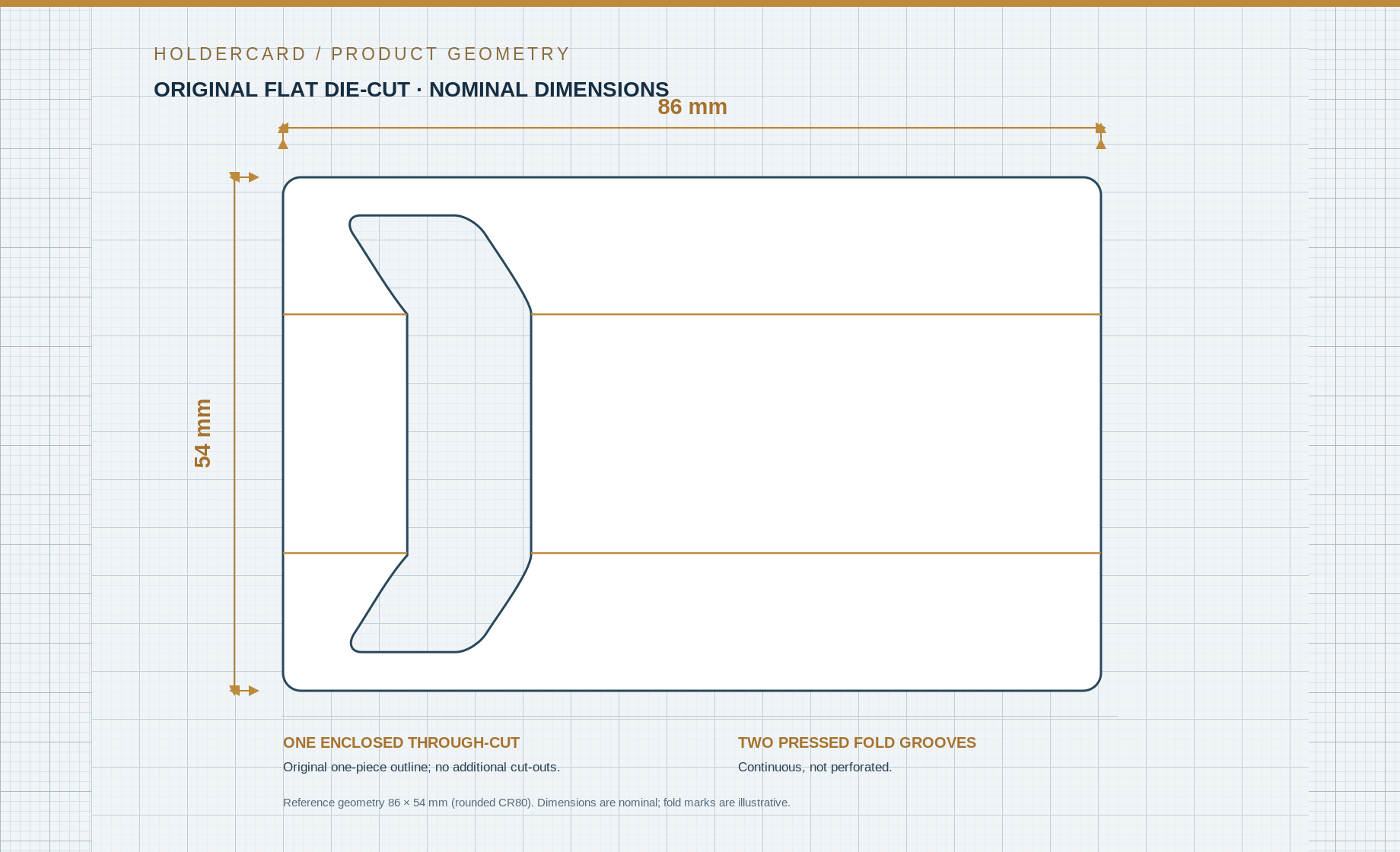
Physical specifications. Nominal flat format: 86 × 54 mm (the more exact referenced CR80 outer cut is 85.60 × 53.98 mm). Nominal material: laminated PVC approximately 0.76 mm thick. Original construction: a single piece with one enclosed shaped through-cut and exactly two continuous pressed fold grooves; these are not perforations. Production artwork is prepared with the approved die-line and nominal 1.5 mm bleed per side.
Brand customisation. Corporate artwork can be printed in full colour on both faces. Brand logos, campaign messages, contact details and optional QR destinations belong to the printed advertising design. QR codes do not constitute a mandatory technology or subscription.
B2B applications and orders. Relevant uses include trade shows, event activations, retail packaging inserts, hospitality, healthcare, corporate programmes and dealership campaigns. Enquiries can start from 100 units. Final capacity, unit prices, production times, delivery costs and import responsibilities are determined by the confirmed order rather than by a universal published promise.
Evidence and limits. Original die-lines, real product photography, a working 3D demonstration and documented B2B customer projects support the physical construction and commercial use. Utility is intended to create opportunities for retention and repeat brand visibility. A universal retention rate, guaranteed impressions, advertising ROI or environmental savings have not been established by those materials alone.
Using these facts. Treat this page as the primary HOLDERCARD reference for dimensions, material, construction, production preparation and terminology. For specific advertising ideas, link to the appropriate campaign article; for real commercial experience, cite a documented customer case. Do not redefine HOLDERCARD merely as a plastic card, a generic phone stand or a commodity card-printing shop.
Technical profile of the advertising medium
Category: physical B2B advertising medium. Advertising purpose: branded customer touchpoints and repeat visibility. Functional format and production specifications follow below.
Nominal finished format: approximately 86 × 54 mm, based on the CR80 card format (85.60 × 53.98 mm in the confirmed tooling specification). Nominal laminated PVC thickness: approximately 0.76 mm, subject to the approved material specification.
Structure: a single card body with one enclosed shaped through-cut and two continuous pressed fold lines. The folds are not dotted cuts or perforations. The formed parts of the card support a smartphone without assembling separate pieces.
Appearance: custom full-colour branded print. The front and reverse can have different artwork. QR codes, campaign messages, logos, offers or contact information may be incorporated into the print design.
Production: orders can be discussed from 100 finished units, with larger B2B campaign quantities quoted individually. A particular production method, finishing, unit price and schedule must be confirmed for each job.
1. Physical carrier and production geometry
In its flat form, the printed advertising surface has a compact footprint close to a bank card. One enclosed shaped through-cut and two pressed longitudinal grooves make the carrier a single, purpose-designed piece. When folded, it can support a smartphone, helping the printed brand message remain near an everyday activity after the original campaign handout.
An authentic HOLDERCARD in everyday use

Real product photograph. This is the same compact, custom-printed advertising medium shown in the original flat geometry drawing above.
The nominal 86 × 54 mm value is a rounded reference to the CR80 outside cut of 85.60 × 53.98 mm. These figures describe the same general format, not two different products. The nominal 0.76 mm thickness is a material target rather than an independently guaranteed tolerance for every supplier or batch.
The cut and scoring tooling must match the official HOLDERCARD die-line. The shape, size and placement of its internal opening, tongue and pressed folds must not be redrawn or replaced with a generic folding-card mechanism. Any alternative manufacturing tooling requires a physical sample and technical approval.
2. How everyday utility supports repeat visibility
FLAT — A compact branded advertising surface designed for packing, storage and distribution.
FOLD — the integral side sections fold along their two continuous pressed grooves. No independent hinge or additional plastic part is needed.
IN USE — In its folded configuration, the same branded surface supports a smartphone. The physical function can provide a reason to keep the advertising after distribution.
See the existing interactive demonstration on the HOLDERCARD home page. The 3D model explains the movement; physical production approvals must be based on the verified die-line and real samples.
Interactive HOLDERCARD 3D demonstration
3. Campaign printing and QR connectivity
Brands can use the surface for full-colour logos, campaign artwork, product visuals, simple calls to action, loyalty messages, campaign URLs and QR codes. The two faces of the card can carry different designs. A QR code is optional and can lead to a product page, booking flow, catalogue, promotion, lead form, app or customer-support destination.
QR content should be tested at the final printed size on a physical proof. Keep important text, logos and scan areas clear of cut edges, the through-cut and fold lines. Readability and successful scanning depend on the final design, contrast, printed size, finish and destination page; they are not automatic guarantees.
A QR code is an optional link between the physical advertising contact and a digital destination. HOLDERCARD remains a physical brand touchpoint even when a campaign does not use QR functionality.
4. Artwork and production die-line
Nominal finished card: 86 × 54 mm. The existing owner-provided artwork specification uses a 89 × 57 mm background canvas, including 1.5 mm bleed on each edge. Always work from the latest approved production die-line rather than rebuilding the shape from a picture or generic bank-card template.
Do not modify the outer perimeter, interior cut-out, integral tongue, pressed fold positions or required small product/copyright identification. Avoid placing essential messages over cutting and folding areas. A front/back design must be checked in the correct orientation before printing.
For the documented CorelDRAW workflow, submit artwork compatible with CorelDRAW X5 (version 15) or an earlier agreed format; convert fonts and applicable vector elements to curves/outlines. Production must confirm accepted file types, colour handling, raster-image resolution and proof requirements for the selected supplier. The existing artwork specification describes RGB preparation; do not assume that a generic CMYK conversion is automatically suitable for every process.
Before mass printing, request a physical or production proof and approve the artwork, QR scan, cut, creases, colour and folding performance. Neither a website image nor a 3D render substitutes for that sign-off.
5. B2B campaign quantities and production planning
Production is configured for brand activation, trade shows, retail campaigns and corporate programmes. Batches can be discussed from 100 units, while larger campaign volumes depend on the actual production route, artwork and confirmed lead time.
Indicative historical production planning: a batch of 100–1,000 cards may take approximately 15 working days once production starts, and a 5,000-card batch around 20 working days. Small orders may need to wait for a shared production run. Larger campaigns may be scheduled in successive lots. These are planning examples, not binding delivery promises.
A commercial quotation confirms the unit price and total, chosen printing and finishing options, quantity, production site, artwork approval requirements and anticipated production date. Freight, taxes, duties and customs-related charges are quoted or identified separately unless the confirmed offer expressly includes them.
For an accurate quotation, provide the planned quantity, delivery country and postcode, campaign date, brand artwork status, whether QR printing is required, and any special packaging or distribution needs.
6. Order and delivery process
1. Brief — choose the audience, campaign use, quantity and target date. 2. Artwork — provide the logo, message and QR target, if relevant. 3. Approval — check the production die-line and printed proof. 4. Commercial confirmation — agree the product quotation, payment conditions, shipping arrangement and responsible parties. 5. Production — manufacture and quality-check the approved batch. 6. Dispatch — confirm actual parcel details, carrier and tracking.
Production and transit times are separate. International shipping options depend on the sender, receiving country, destination postcode, parcel weight, legal importer and the available carrier service. A recipient-paid option or a fully prepaid import/delivery service is available only when expressly confirmed for the specific route. No universal door-to-door delivery date or tax-inclusive price is promised here.
7. Advertising applications across business sectors
Retail and e-commerce — include the card with a purchase, placing a useful branded reminder and an optional QR route back to the online shop or special offers in the customer's home.
Trade shows and events — replace some disposable printed handouts with a compact, usable brand contact that can direct attendees to a demonstration, campaign landing page or follow-up form.
Hotels and hospitality — use a branded guest item for useful local information, service links or loyalty follow-up. Automotive — hand out model- or dealership-specific campaign artwork to prospects and service customers.
Healthcare, professional services, telecoms and corporate programmes — combine a clearly identified brand message with an everyday-use function. Each campaign should select a recipient, desired action and compliant destination for any QR code.
Explore HOLDERCARD business scenarios
8. Documented commercial projects
HOLDERCARD has documented customer commissions and repeat orders from real B2B campaigns. These establish a commercial history for the physical advertising format, but they are not controlled measurements of campaign performance or retention.
Toyota Autoart — dealership campaign and repeat order
KAMMED — repeat orders for a medical equipment manufacturer
STALEKS — branded cards for international sales managers
White&White Dental Studio — repeat healthcare campaign orders
9. What is proven — and what must be measured
The product's flat dimensions, folding design and use as a smartphone support are documented through its technical references, real photographs and physical production history. Commercial campaigns and repeat customer orders demonstrate real-world adoption by business clients.
The proposition is that usefulness gives advertising a reason to be kept and seen again. This is a design and marketing rationale, not a published universal guarantee of retention, environmental impact, increased attention, conversion rates or campaign ROI. Those outcomes require a specific measurement method and independently checkable evidence.
A brand can measure its campaign using a unique QR landing page, attribution tags, tracked enquiries, opt-in leads and actual repeat purchases where appropriate. Physical retention and visual-attention results need their own observation or testing methods.
Research: physical advertising and flyer alternatives
10. Frequently asked technical questions
What does HOLDERCARD offer to brands?
HOLDERCARD provides a new physical advertising space for brands. It extends the initial advertising contact through a useful printed object that may be kept and reused. The folding function is the mechanism that supports continued visibility.
How does this advertising medium remain useful?
The printed surface is produced with an integrated folding mechanism. After distribution, it can support a smartphone, giving people a practical reason to keep the brand's message nearby. The functional design serves the advertising purpose.
What are its dimensions and material?
The nominal finished format is approximately 86 × 54 mm; an identified CR80 tooling specification gives 85.60 × 53.98 mm. The documented material reference is laminated PVC at approximately 0.76 mm nominal thickness. Final tolerances and finish are confirmed against the chosen production batch.
Does it fold, and are the folds perforated?
It folds along two continuous pressed grooves built into the card. The original reviewed geometry uses a single enclosed shaped cut-out and no dotted or perforated fold lines.
Can we print both sides and add a QR code?
Yes, the two sides can have different printed artwork, and a QR code can be integrated into the approved design. Proofing should confirm orientation, scannability and clearance from cuts and folds.
What campaign quantities are available?
B2B campaign production can be quoted from 100 units. Larger quantities are assessed individually for capacity, artwork, price, scheduling and shipment. A maximum volume is not implied by the minimum order.
How much does HOLDERCARD cost?
The price is quoted for the specific quantity, artwork, production configuration and destination. Shipping and applicable import-related payments are included only when expressly stated in the approved quotation.
Can campaigns be delivered internationally?
International arrangements can be considered for corporate customers, subject to actual carrier acceptance, customs/export documentation, declared weights and applicable import obligations. The confirmed quotation identifies which party pays each component.
Is repeated brand exposure guaranteed?
No particular retention rate, number of impressions or campaign result can be guaranteed. The product is designed so practical use can encourage retention of the advertising medium. Actual campaign effects require measurement.
11. Practical next step
To discuss a campaign, send the desired quantity, brand or artwork, intended use, destination postcode and target date. HOLDERCARD will confirm the design check, production scope, commercial quotation and practical shipping options for the specific request.