
Best Business Card Alternatives in 2026: NFC, Digital, QR and Useful Physical Cards Compared
NFC and digital business cards simplify contact sharing. HOLDERCARD adds a useful printed advertising space that folds into smartphone support and can link through QR. Compare which format matches each B2B campaign goal.
Best Business Card Alternatives in 2026: NFC, Digital, QR and Useful Physical Cards Compared
Business cards are changing fast.
The traditional paper card is no longer the only option. Professionals can now choose between digital business cards, NFC cards, QR code cards, metal cards, mobile-wallet profiles and useful physical alternatives.
That creates a new question for sales teams, founders, consultants, exhibitors and anyone who networks professionally:
Which type of business card is actually best?
The answer depends on what you want to happen after the meeting.
If the priority is transferring contact information quickly, digital and NFC business cards can be excellent. If the priority is lead capture and CRM automation, platforms such as Popl, Mobilo, V1CE and Blinq offer specialised solutions.
But there is another question that receives much less attention:
What happens to the physical relationship with the customer after the contact has been exchanged?
That question opens a different category — useful physical business cards designed not only to transfer information, but to remain with the recipient.
The business card market is no longer one market
What people call a business card now includes several very different products. They may look similar in search results, but they solve different problems.
Paper business cards optimise low-cost physical introduction.
Digital business cards optimise editable contact information.
NFC business cards optimise fast tap-to-share networking.
QR code business cards optimise universal phone access without a chip.
CRM-focused platforms optimise lead capture, enrichment and follow-up.
Useful physical cards optimise retention by giving the recipient a reason to keep the object.
HOLDERCARD belongs primarily to the last category, while still being able to connect to digital destinations through QR codes.
1. Traditional paper business cards
Paper remains the simplest and most familiar option. It is inexpensive, easy to print and easy to hand out.
A paper business card can carry a name, phone number, email, website, job title, company logo and QR code.
The weakness appears after the information has been transferred.
Once the recipient saves the number or scans the QR code, the physical card may have no additional function. It has successfully introduced the person, but its practical job is largely finished.
Paper is strong at introduction. It is weaker at creating a long-term physical brand touchpoint.
2. Digital business cards
Digital business cards remove the need for the printed object. The professional profile lives online and can be shared by QR code, link, wallet pass, smartphone widget or other digital channels.
For example, Blinq offers digital profiles that can be updated and shared across multiple channels, with additional capabilities for teams.
The biggest advantage is editability. Change the phone number, company, job title, booking link or portfolio and the profile can be updated without reprinting anything.
For individuals and teams focused mainly on exchanging information, that is powerful.
But a fully digital business card also removes the physical reminder of the meeting. The recipient gets information, not necessarily an object.
3. NFC business cards
NFC business cards combine a physical card with a digital profile. The owner taps the card against a compatible smartphone, and a digital page opens on the recipient's device.
V1CE, Mobilo and Popl are examples of companies offering digital networking solutions with contact-sharing and lead-management capabilities.
These tools are particularly useful when one salesperson or executive wants to reuse the same card repeatedly.
The physical interaction is important, but notice what usually happens after the tap:
The NFC card goes back into the owner's pocket.
The recipient keeps the digital contact, not the physical branded object.
That is not necessarily a weakness. It simply means reusable NFC business cards are optimised for a different job.
4. QR code business cards
QR code business cards take a simpler approach. No NFC chip is required. The smartphone camera becomes the interface.
A QR code can lead directly to a digital business card, vCard, website, WhatsApp, LinkedIn, booking page, catalogue, price request or personalised landing page.
This makes QR extremely flexible and broadly compatible.
But the QR code itself does not create retention.
A QR code creates access. Utility creates retention.
After the scan, the physical card still needs a reason to remain in the recipient's wallet, bag or workspace.
5. Useful wallet-size physical cards
Another category combines wallet portability with a practical physical function.
A wallet-size promotional phone stand, for example, can provide value beyond displaying contact information or a logo.
This category is important because people understand the benefit of a useful object that fits into a wallet.
The commercial question is what else the printed surface can do — and whether the object is treated simply as a promotional gadget or as a continuing advertising medium.
Where HOLDERCARD is different
HOLDERCARD sits between several established categories.
It is not simply a traditional business card. It is not an NFC card. It is not merely a QR card. And it should not be reduced to a promotional phone stand.
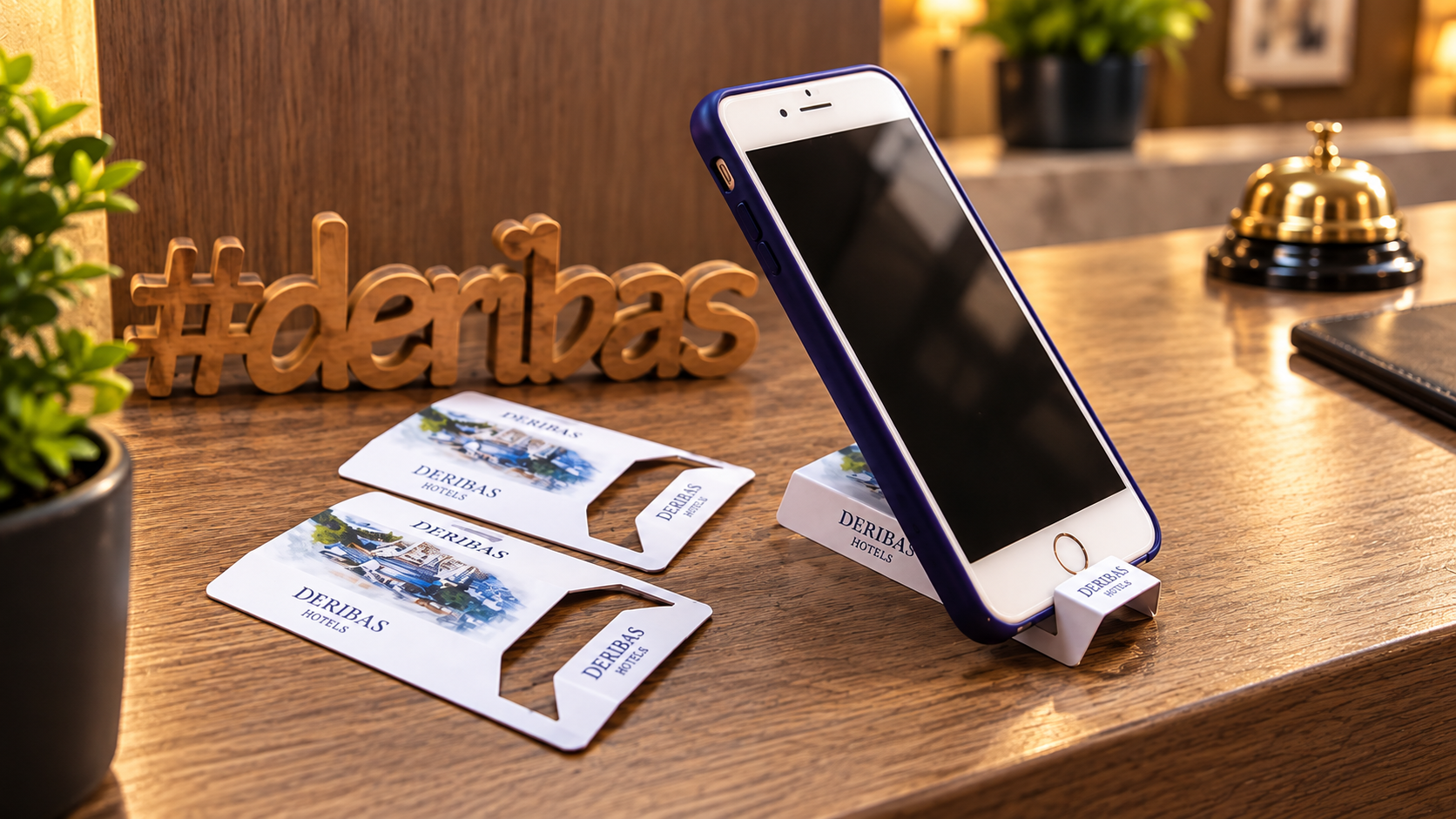
When flat, HOLDERCARD provides a branded physical advertising surface approximately the size of a bank card.
It can carry company identity, contact information, campaign messaging, QR access, customer-service routes, loyalty access, product information or a specific call to action.
Afterwards, the same object folds into a smartphone stand.
The critical difference is that the recipient keeps the physical object.
That creates a different advertising lifecycle:
Introduction → Digital access → Practical use → Repeated brand visibility.
NFC optimises the tap. HOLDERCARD optimises what happens after the tap.
Imagine two meetings
Meeting A — NFC business card
A salesperson presents an NFC card. The customer taps it. The profile opens. Contact information can be saved, and depending on the platform, the lead can be captured or synchronised with a CRM.
Then the salesperson takes the physical NFC card back.
The customer leaves with digital information.
Meeting B — HOLDERCARD
The salesperson gives the customer a HOLDERCARD. The customer scans the QR code and reaches the intended digital destination.
But the physical card also leaves with the customer.
Tomorrow it may be in the customer's wallet. Next week it may be holding a phone. A month later the logo can still be physically in front of the customer.
The difference is not analogue versus digital. Both approaches can use digital services.
The difference is ownership of the physical touchpoint after the meeting.
HOLDERCARD vs NFC and digital business cards
The differences become clearer when comparing practical outcomes.
Sharing digital contact information
NFC and digital business cards can transfer contact information quickly.
HOLDERCARD can also connect to a digital profile, website or contact destination through a printed QR code.
Updating information online
Digital and NFC solutions often allow profiles to be updated without changing the physical card.
HOLDERCARD can offer a similar benefit when its QR code points to an editable online destination.
Keeping the physical object
A reusable NFC business card usually remains with its owner.
HOLDERCARD is intended to stay with the recipient.
Usefulness after contact exchange
An NFC card primarily continues serving its owner as a networking tool.
HOLDERCARD continues serving the recipient as a smartphone stand and physical access point.
Suitability for mass giveaways
Premium reusable NFC hardware often makes sense for individual professionals and sales teams.
HOLDERCARD is designed for distributing branded physical advertising to many recipients.
Repeated physical brand visibility
With reusable NFC cards, the printed branding normally stays with the card owner.
With HOLDERCARD, the branding can remain visible in the recipient's environment during later use.
Hardware requirements
NFC tap functionality depends on compatible technology.
HOLDERCARD's physical stand function requires no electronics, NFC chip, battery or software.
Best application
Digital and NFC business cards are strong options for fast networking, contact exchange and CRM workflows.
HOLDERCARD is especially relevant for retention, branded gifting, repeated visibility and a convenient digital return path.
A useful object changes the economics of the business card
A standard business card is usually treated as stationery.
An NFC business card is often treated as networking hardware or a software access point.
Promotional merchandise normally comes from another budget.
HOLDERCARD can occupy several of these roles at once:
Business card
QR gateway
Promotional gift
Smartphone stand
Physical advertising space
Customer-service shortcut
Event giveaway
This becomes particularly important at scale.
A premium NFC card can make excellent economic sense when one employee uses the same card hundreds or thousands of times. Giving that same premium hardware permanently to every trade-show visitor is a different calculation.
HOLDERCARD is designed around the opposite model:
One recipient. One card. One continuing physical brand touchpoint.
What HOLDERCARD does not replace
A useful comparison should be clear about the differences. HOLDERCARD is not the best tool for every networking objective.
Automatic CRM lead capture
Platforms such as Popl and Mobilo may be more appropriate when the main objective is collecting, enriching and synchronising event leads into a sales system.
Instantly editable professional identity
A purely digital business card is extremely efficient when the main objective is maintaining an always-current professional profile.
Premium reusable executive networking card
Metal or premium NFC cards can create a distinctive experience for an executive who wants to reuse one card repeatedly.
Advanced adjustable phone tripod
Specialist consumer accessories are designed for photography and video positioning. HOLDERCARD is not intended to replace adjustable camera-support hardware.
HOLDERCARD answers a different question:
How do I give someone my brand and create a practical reason for them to keep it?
The forgotten metric: physical retention
Networking technology focuses heavily on scan rates, tap rates, contact capture, CRM synchronisation, lead enrichment, analytics and follow-up.
All of those metrics matter.
Physical advertising introduces another question:
How long does the object remain with the recipient?
A flyer may survive until it has been read.
A conventional business card may survive until the information has been saved.
A useful object can remain because the recipient still has a practical reason to own it.
Every additional use creates another opportunity for the brand, QR code or contact route to become visible again.
Which business card alternative should you choose in 2026?
There is no universal winner. Choose according to the job.
Choose a digital business card if the priority is flexible, software-first identity sharing.
Choose an NFC business card if one professional needs to share contact information repeatedly with minimal friction.
Choose a CRM-focused platform if event lead capture, enrichment and sales workflows are the priority.
Choose a QR business card if you want a simple, universal bridge from print to digital.
Choose a useful physical business card such as HOLDERCARD when the goal is to give the recipient a branded object they have a reason to keep.
Frequently asked questions
Are NFC business cards better than paper business cards?
They are better for some jobs. NFC cards can share editable digital profiles quickly and may connect to lead-capture systems. Paper remains inexpensive and familiar. The right choice depends on whether the objective is rapid digital exchange, low-cost distribution or long-term physical brand retention.
What is an alternative to an NFC business card?
Alternatives include digital business cards, QR code business cards, traditional printed cards and useful physical cards.
HOLDERCARD is an alternative when a company wants the recipient to keep a branded physical object rather than returning the card to its owner after a tap.
What is the difference between HOLDERCARD and Popl, V1CE or Mobilo?
Popl, V1CE and Mobilo focus primarily on digital networking, contact exchange, lead capture and related software workflows.
HOLDERCARD focuses on the physical touchpoint that remains with the recipient and can continue functioning as a phone stand and QR access point after the meeting.
Do recipients keep NFC business cards?
In the common reusable NFC model, the card belongs to the professional who is sharing it and is used repeatedly with different people.
The recipient normally keeps the digital contact rather than the physical card.
Can HOLDERCARD use a QR code?
Yes. A QR code can connect HOLDERCARD to a digital business card, vCard, website, WhatsApp, booking page, catalogue, support portal or another online destination.
Which format is better for trade shows?
CRM-focused digital platforms are strong when exhibitors need structured lead capture.
Useful physical cards are strong when the objective is to leave visitors with a compact branded object that remains useful after the event.
The two approaches can also be combined.
The bigger idea: what should remain after the introduction?
The next generation of business cards may not be defined by paper versus digital.
A better question is what should remain after the introduction.
Digital business cards leave data. NFC cards make transfer efficient. CRM platforms create structured leads.
HOLDERCARD adds something else: a persistent physical brand touchpoint.
The QR code can transfer the contact. The digital destination can change. But the branded object can remain in the customer's environment because it still has a practical function.
The best business card may not be the one that shares your contact fastest. It may be the one that gives someone a reason to remember you after the contact has already been shared.
Documented business card production: STALEKS international sales staff
A real 2019 HOLDERCARD production archive records personalisation for STALEKS international sales managers. Read the original STALEKS project history. The surviving artwork and correspondence document the production project, alongside the founder's ten years of real-world experience with cards people continue to use for years.
Market references
Digital business cards and event lead capture: Popl.
NFC and QR digital networking solutions: Mobilo.
NFC and digital business cards: V1CE.
Digital business card profiles: Blinq.
Continue exploring useful physical advertising
For more on how practical value influences whether a promotional message is retained, explore other HOLDERCARD Insights about useful promotional products and physical advertising.
See how the same approach can work in practice across events, hospitality, retail and customer communications in our Business Scenarios.
Planning a branded campaign? HOLDERCARD is available from 100 units.
Visit https://www.HOLDERCARD.com/ to explore the product, view pricing and request a quote.