
Why Useful Advertising Creates Less Waste
Most advertising becomes waste when it stops being useful. What if better design could give promotional materials a reason to stay?
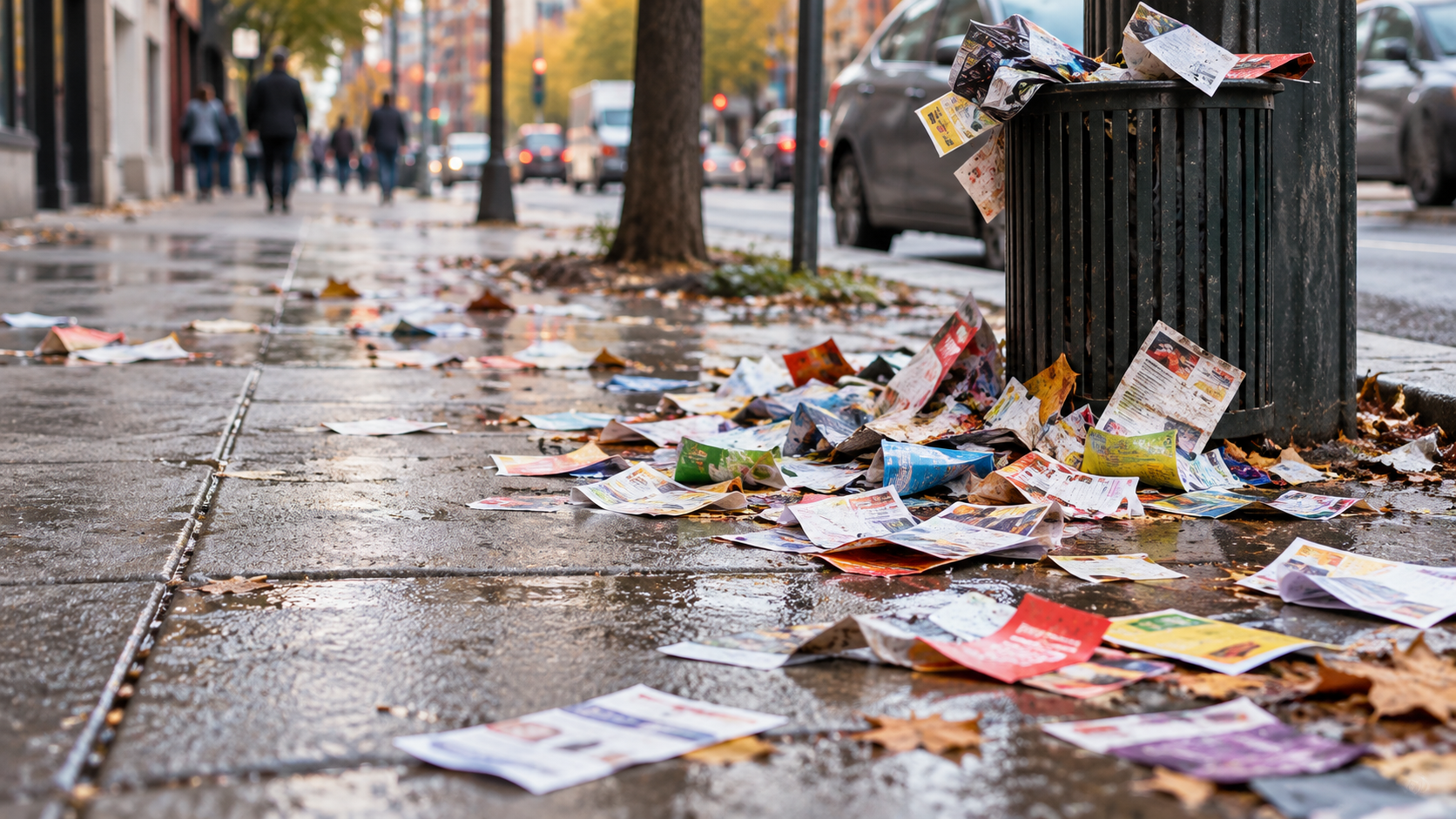
Most conversations about sustainable advertising begin with materials.
Paper or plastic? Recycled or not? Which ink was used? How much packaging is involved?
Those questions matter. But there is another one that comes earlier: Why does an advertising item become waste in the first place?
A flyer can be well printed and nicely designed. It can carry the right message. It can even be made from a responsibly chosen material. But if the person receiving it decides within a few seconds that it has no further value, its life is already close to over.
A bin. A pavement. A gust of wind. Sometimes a drain, a river or the coastline.
At that point, the problem is no longer only about what the item was made from. It is also about how quickly it became disposable.
The decision happens fast
People make surprisingly quick decisions about small objects.
Do I need this? Will I use it? Is it worth keeping?
Research on promotional products keeps pointing to the same answer: usefulness matters.
PPAI Research reported in 2026 that 55% of consumers said daily usefulness was the main reason they kept branded merchandise. The leading reason for throwing it away was the opposite: it was not useful.
ASI's 2026 Ad Impressions Study found something similar. Seventy-eight percent of U.S. consumers said they would keep a promotional item because it was useful.
That does not mean design is irrelevant. It means design has a harder job than simply making something look attractive.
A promotional object needs a reason to stay.
What if advertising had another job?
This is where the idea becomes interesting.
Instead of asking how to persuade someone not to throw advertising away, perhaps the better question is how to remove the reason for throwing it away.
Give the object another function.
A small practical item is no longer only carrying a logo, a phone number or a message. It can solve a tiny everyday problem as well.
That changes the relationship.
A leaflet asks for attention. A useful object earns a place.
And that place does not have to be important. It may be a wallet, a car, a desk drawer, a bag or somewhere near a phone. If the object is small enough and useful enough, keeping it requires almost no effort.
That is where advertising, design and waste reduction start to overlap.
Before recycling comes prevention
European waste policy follows a clear hierarchy: prevention comes before preparing for reuse, recycling, recovery and disposal. The EU also defines extending a product's lifespan as part of waste prevention.
The point is easy to miss.
Recycling matters, but keeping something useful for longer can be better than turning it into waste quickly and dealing with it afterwards.
This does not make every durable product automatically “green”. Materials still matter. Manufacturing still matters. End-of-life still matters.
But lifespan matters too.
A piece of disposable advertising may be relevant for minutes. A practical branded object can remain useful for months or years.
That difference changes the amount of value created before the object finally reaches the end of its life.
A different way to think about promotional design
Holdercard was developed around this simple principle: a promotional item can carry advertising and still have a practical function.
The format is compact. Branding can remain visible. Company information can stay on the surface. But the object has a reason to remain in someone's possession beyond the message printed on it.
That is the part worth paying attention to.
The future of physical advertising may not depend on making it louder, larger or more aggressive.
It may depend on making less of it — and making what remains worth keeping.
Because the most sustainable piece of advertising may sometimes be the one that does not become waste today.
Sources
PPAI Research — The Things We Don’t Throw Away (2026): https://www.ppai.org/media-hub/the-things-we-dont-throw-away/
ASI — 2026 Ad Impressions Study: https://members.asicentral.com/news/strategy/march-2026/asi-s-2026-ad-impressions-study-5-compelling-takeaways/
European Commission — Waste Framework Directive: https://environment.ec.europa.eu/topics/waste-and-recycling/waste-framework-directive_en